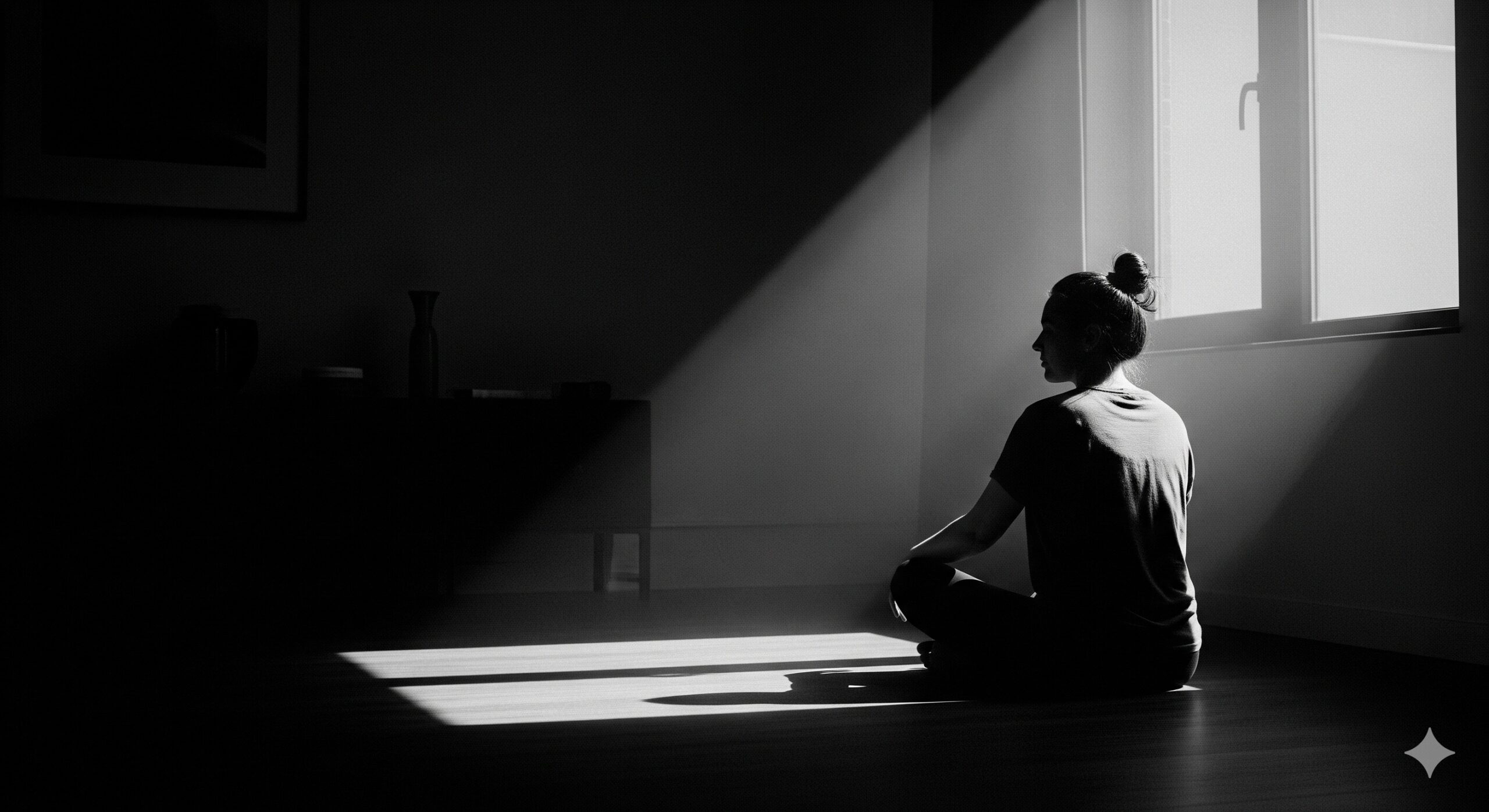
Introduction: The 3:00 AM Ceiling Stare
It usually starts with a hum. A low-level background noise in the back of your head that says, “You forgot something.” Or maybe, “They didn’t like the tone of your email.”
By 3:00 AM, the hum has turned into a roar. You are lying in bed, staring at the shadows dancing on the ceiling, your body exhausted but your mind running a marathon. You are rehearsing conversations that happened five years ago and dreading meetings that haven’t happened yet. Your chest feels tight, a sensation often described as an invisible elephant sitting on your ribs.
If this sounds familiar, you aren’t alone. In our hyper-connected, always-on world, anxiety has become the background radiation of our lives. We treat it with caffeine to power through, wine to wind down, and endless scrolling to distract ourselves.
But what if the antidote wasn’t about adding more to our lives, but about peeling things away?
We’ve all heard that “meditation helps.” It’s become a cliché, tossed around alongside advice to “drink more water.” But for people suffering from genuine, debilitating anxiety, generic advice feels insulting. You can’t just “breathe away” a panic attack, right?
Actually, the science—and the stories of real people—suggests that you can do something even more profound: you can physically rewire the hardware of your brain.
In this deep dive, we aren’t just going to list the benefits of mindfulness. We are going to look at three specific case studies of individuals who used meditation to dismantle their anxiety, not by magic, but by practice.
The Science of the “False Alarm”
Before we meet Sarah, Mark, and David, we need to understand the machinery they were up against.
Anxiety is not a character flaw. It is a biological safety mechanism gone rogue.
Deep inside your brain is an almond-shaped structure called the amygdala. This is your brain’s smoke detector. Its job is to scan the environment for threats. When it spots a tiger, it screams “DANGER!” and floods your body with cortisol and adrenaline. Your heart rate spikes, your digestion stops, and your muscles tense up. This is the Fight-or-Flight response.
The problem? In modern life, there are no tigers. Instead, there are passive-aggressive emails, unpaid bills, and awkward social interactions. The amygdala, however, cannot tell the difference between a predator and a deadline. It pulls the fire alarm regardless.
Meditation does not silence the amygdala instantly. Instead, it strengthens the Prefrontal Cortex—the CEO of the brain. This is the part responsible for logic, planning, and emotional regulation.
When you meditate, you are effectively building a thicker, stronger connection between the CEO and the smoke detector. You are training the CEO to look at the alarm and say, “Thank you for the warning, but that’s just a rude comment on Instagram, not a sabertooth tiger. We can stand down.”
Here is what that looks like in real life.
Case Study 1: The “High-Functioning” Perfectionist
Name: Sarah, 34 Role: Senior Marketing Director Primary Struggle: Generalized Anxiety & Imposter Syndrome
Sarah was the person everyone envied. She was promoted twice in three years, ran marathons, and seemingly had endless energy. But internally, Sarah was crumbling.
Her anxiety manifested as “High-Functioning Anxiety.” To the outside world, she was driven. Inside, she was running from a terrifying fear of failure. Every silence in a meeting convinced her she was about to be fired. Every email notification triggered a spike of adrenaline. She lived in a state of constant, low-grade hyperarousal.
“My mind was like a browser with 40 tabs open, and three of them were frozen and playing loud music I couldn’t turn off,” Sarah described.
The Intervention: Mindfulness-Based Stress Reduction (MBSR)
Sarah hit a wall when she developed chronic migraines. Her doctor suggested an 8-week MBSR course. Sarah was skeptical. “I don’t have time to sit and do nothing,” she argued. “I have work to do.”
But she committed to 10 minutes a day.
The Struggle
For the first three weeks, Sarah hated it. Sitting in silence made her anxiety louder. Without the distraction of work, her inner critic screamed. She felt itchy, irritated, and bored.
This is a common hurdle known as the “Backdraft” effect. When you open a door to a burning room, the oxygen rushes in and the fire flares up. When you finally stop running and sit with yourself, the suppressed anxiety rushes to the surface.
The Breakthrough
Sarah’s breakthrough came in week five. She was in a high-stakes board meeting. The CEO frowned at her slide deck. Usually, this micro-expression would have sent Sarah into a spiral of panic: He hates it. I’m incompetent. I’m going to lose my house.
Instead, a split second of space opened up. Sarah noticed her chest tightening. She noticed the heat in her face. And because of her practice, she was able to label it: “Fear is here.”
She didn’t fight the fear. She didn’t believe the story the fear was telling her. She just felt the sensation, took a breath, and continued her presentation.
The Result
Sarah didn’t become a “zen master.” She still gets stressed. But the recovery time has changed.
- Before: One critique would ruin her week.
- After: One critique ruins her next 10 minutes, and then she moves on.
Key Takeaway: Meditation doesn’t stop negative thoughts. It stops you from becoming your negative thoughts. It creates the “gap” between stimulus and response.
Case Study 2: The Somatic Worrier
Name: Mark, 42 Role: Graphic Designer Primary Struggle: Health Anxiety (Hypochondria) & Panic Attacks
Mark’s anxiety wasn’t about work; it was about his body.
It started after a minor heart flutter (which turned out to be benign). Mark became hyper-fixated on his physical sensations. A headache was a tumor. A numb foot was a stroke. Indigestion was a heart attack.
He was caught in a “Panic Loop.”
- He feels a sensation.
- The amygdala interprets it as a threat.
- Adrenaline is released.
- The adrenaline causes more physical symptoms (racing heart, dizziness).
- Mark interprets these new symptoms as confirmation that he is dying.
- Full-blown panic attack.
The Intervention: The Body Scan and Breathwork
Mark couldn’t do standard “watch your thoughts” meditation because his thoughts were too terrifying. Instead, he worked with a somatic therapist who introduced him to Grounding and the Body Scan.
The goal was to re-friend his body.
The Practice
Every evening, Mark lay on the floor. He would systematically move his attention from his toes to his head.
- “Feel the left big toe. Is it warm? Cold? Tingly? Numb?”
- “Feel the ankle.”
When he reached his chest (the source of his anxiety), he was instructed to “breathe into the tightness.”
The Breakthrough
One afternoon, Mark felt a sharp pain in his side. The panic wave started. “This is it. Kidney failure.”
He instinctively dropped into his practice. He directed his attention at the pain, rather than running from it. He visualized his breath flowing around the sensation. He asked himself, “Is this sensation actually dangerous right now, or is it just unpleasant?”
As he observed the pain with curiosity rather than fear, the adrenaline didn’t spike. The loop was broken. The pain faded five minutes later (it was gas).
The Result
Mark rewired his brain’s interpretation of physical signals. He learned to distinguish between sensation and catastrophe. His panic attacks, which used to happen three times a week, haven’t occurred in six months.
Key Takeaway: Anxiety often lives in the body, not just the mind. Somatic meditation helps us distinguish between discomfort and danger.
Case Study 3: The Social Phobic
Name: David, 26 Role: Software Developer Primary Struggle: Social Anxiety & Isolation
David was comfortable with code, but terrified of people. He believed that in every social interaction, he was being judged and found wanting. He avoided eye contact, mumbled, and eventually stopped going out altogether.
His internal narrative was a constant stream of self-judgment: “You look stupid. Why did you say that? They are laughing at you.”
The Intervention: Metta (Loving-Kindness) Meditation
David didn’t need to focus on his breath; he needed to change his relationship with himself and others. He started practicing Metta Bhavana, or Loving-Kindness meditation.
This is a practice where you actively generate feelings of goodwill.
- For yourself: “May I be happy. May I be safe.”
- For a loved one: “May you be happy.”
- For a neutral person (like a cashier): “May you be happy.”
- For a difficult person: “May you be happy.”
The Struggle
“It felt fake,” David admitted. “I was sitting there repeating these phrases, but I felt nothing. I felt silly.”
This is common. We expect meditation to feel like a warm bath immediately. But Metta is like lifting weights; the repetition is the exercise, even if you don’t feel “strong” while doing it.
The Breakthrough
David had been practicing for two months when he went to a grocery store. The cashier was moving slowly, and the person in front of David was sighing loudly, clearly angry.
Normally, David would have absorbed that tension, stared at his shoes, and felt anxious.
Instead, a phrase popped into his head automatically: “May you be peaceful.”
He looked at the angry customer. Instead of seeing a threat, he saw a person who was suffering. He looked at the flustered cashier. He saw a person doing their best.
His fear dissolved, replaced by a strange, quiet warmth. He smiled at the cashier when it was his turn. She smiled back. It was a 10-second interaction, but for David, it was a mountain conquered.
The Result
David realized that his social anxiety was rooted in self-obsession—he was so worried about how he appeared that he couldn’t see others. Metta flipped the script. By focusing on wishing others well, his brain didn’t have the bandwidth to obsess over his own awkwardness.
Key Takeaway: Compassion is an antidote to fear. You cannot be in a state of judgment and a state of love at the same time.
Why It Works: The Neuroplasticity of Peace
These stories aren’t miracles. They are biology.
For decades, scientists believed the adult brain was fixed—that if you were an “anxious person,” you were stuck that way. We now know this is false. The concept of Neuroplasticity proves that neurons that fire together, wire together.
Every time you engage in an anxious thought loop (“What if I fail?”), you are strengthening a neural highway of fear. You are paving that road, adding lanes, and putting up streetlights.
Every time you meditate, you are:
- Noticing you are on the fear highway.
- Choosing to get off at the nearest exit.
- Returning to the breath (or the present moment).
This act of returning is the “rep.” It creates a new dirt path in the brain. Over time, that dirt path becomes a paved road, and the old highway of anxiety becomes overgrown with weeds from lack of use.
Studies from Harvard and MRI scans have shown that after just eight weeks of consistent meditation practice:
- The Amygdala (fear center) shrinks in volume.
- The Hippocampus (memory and emotional regulation) thickens.
- The Vagus Nerve tone improves, allowing your body to switch from “Fight or Flight” to “Rest and Digest” faster.
A Practical Guide: How to Start (Without Giving Up)
If you are reading this and thinking, “Okay, I want to try, but I can’t clear my mind,” listen closely:
You are not supposed to clear your mind.
Trying to clear your mind is like trying to flatten waves in the ocean with a flatiron. It doesn’t work. The goal is not to stop the waves; the goal is to learn to surf.
Here is a simple, non-intimidating routine to start rewiring your anxiety today.
The “5-Minute Anchor” Technique
- Find a Spot: You don’t need a cushion or incense. Just a chair where you won’t be disturbed.
- Set a Timer: Start with 5 minutes. Do not try to be a hero and do 30.
- The Check-In: Close your eyes. Ask yourself, “What is the weather like inside me right now?” Is it stormy? Foggy? Sunny? Don’t try to change it. Just acknowledge it.
- Find the Anchor: Locate where you feel your breath the strongest. The tip of the nose? The rise of the belly? This is your Anchor.
- The Wandering: Within 10 seconds, you will think about lunch, or an email, or why your knee itches. This is not a failure. This is the moment of magic.
- The Return: The moment you realize, “Oh, I’m thinking,” gently escort your attention back to the Anchor. Do this with the kindness you would show a puppy training to sit.
- Repeat: You will likely have to do this 50 times in 5 minutes. That means you did 50 “reps” of brain training.
When Anxiety Spikes During Meditation
If you sit down and your heart starts racing, try this modification:
- Open your eyes.
- Find 5 things you can see (a lamp, a crack in the wall, a book).
- Find 4 things you can physically feel (butt on the chair, feet on the floor).
- Find 3 things you can hear.
- Find 2 things you can smell.
- Find 1 thing you can taste.
This engages the sensory cortex and pulls energy away from the amygdala.
Conclusion: The Long Game
Meditation is not a pill. It doesn’t work in 20 minutes. It works in 20 days, and 20 months, and 20 years.
Sarah, Mark, and David didn’t cure their lives of difficulty. Sarah still has deadlines. Mark still gets sick. David still feels awkward sometimes.
The difference is that they are no longer held hostage by their reactions. They have discovered that inside the hurricane of anxiety, there is an eye—a quiet center that remains untouched.
You don’t have to live at the mercy of your amygdala. You can pick up the phone, call off the false alarm, and reclaim your life. One breath at a time.
Are you ready to start your practice? If you found this article helpful, share it with someone who needs a little peace today.